The Soulforge Is Open
A World First for Bitcoin NFTs
Today, Dungeon Saga introduces what we believe is the first—and currently the only—complete, non-custodial Forge and Unforge lifecycle in the history of BTC NFTs.
SOULFORGE
A New Primitive for Bitcoin NFTs
Introduction
Bitcoin NFTs have largely been defined by permanence.
They can be inscribed, collected, transferred, and preserved. That permanence is one of Bitcoin’s greatest strengths: an asset can exist with a clear identity and history without depending on a centralized platform to keep it alive.
But permanence does not have to mean immobility.
What if a Bitcoin-native asset could change form without destroying the assets that came before it? What if several NFTs could be assembled into a new NFT, transferred as a single object, and later reversed back into the exact originals? And what if the entire lifecycle could happen without asking users to surrender custody to a project wallet?
Today, Dungeon Saga introduces Soulforge—what we believe, based on publicly available information and to the best of our knowledge, is the first complete non-custodial Forge → Bind → Transfer → Unforge lifecycle for BTC NFTs, enforced through BTC-native UTXO smart contracts on OP_CAT Layer.
The concept is simple to experience.
Collect eight standard Dungeon Saga NFT parts, with an optional Bonus. Forge those parts into a complete Hero. Hold or transfer that Hero freely. If the current owner later chooses to Unforge it, the Hero is retired and the exact original NFTs used to create it are released to that owner.
The important part is what does not happen.
The original NFTs are not burned during Forge. They are not exchanged for replacement tokens. They are not deposited into a Dungeon Saga-controlled wallet. No centralized operator receives a private key capable of withdrawing the locked parts.
Instead, the originals enter a contract-controlled UTXO state. The newly created Hero is cryptographically bound to those exact assets and becomes the transferable right to release them through the valid Unforge path.
This makes the Hero more than a visual composition. It becomes a verifiable structure of ownership, provenance, and recoverable assets.
Soulforge was designed first for the Dungeon Saga universe, where fragments become Heroes and Heroes carry their origins into a larger world of story, identity, community, and gameplay. But the underlying idea points beyond one collection or one game.
It suggests a broader possibility for Bitcoin-native assets: digital objects that can be assembled, transformed, transferred, and recovered while preserving their original history and without surrendering custody to a centralized intermediary.
Bitcoin gave digital artifacts permanence.
Soulforge asks what happens when permanence can evolve.
FORGE THE HERO. OWN THE ORIGIN. UNFORGE THE LEGEND.
Heroes Should Be Forged, Not Manufactured
Most NFTs are created in a single moment.
A mint occurs. An image appears. A new asset exists.
For Dungeon Saga, that never felt like the right origin for a Hero.
The world of Dungeon Saga is built around fragments of history: fallen kingdoms, forgotten relics, ancient factions, and the remains of legends scattered across the Ancient Dungeon. A Hero should not simply appear because a backend generated one. A Hero should emerge from the pieces that made that identity possible.
That idea shaped the NFT architecture from the beginning.
A complete Dungeon Saga Hero is assembled from eight standard NFT parts, with an optional Bonus. Those parts are independently owned assets before the Forge. They have their own identities and provenance. When brought together in the correct configuration, they can awaken a complete Hero.
The design challenge was therefore not simply, “How do we combine eight images?”
It was: “How do we let eight real Bitcoin-native assets become a new, freely transferable asset without erasing the originals—and without asking the holder to trust us with custody?”
That question is the foundation of Soulforge.
A conventional crafting system can solve the visual problem easily. Burn the inputs, mint the output, and move on. But that approach destroys the relationship between the final object and the assets that produced it.
Soulforge preserves that relationship.
The Hero exists because its original parts still exist.
The parts remain the Hero’s origin. The Hero becomes their new expression. And the connection between the two survives ownership changes.
In lore, a Hero carries the relics and scars of the path that forged them.
In Soulforge, that history is not merely narrative.
It is part of the asset structure itself.
Beyond Burn-to-Mint
NFT crafting has traditionally relied on one of two patterns.
The first is burn-to-mint. The original assets are destroyed and a new asset is issued in their place.
The second is custody-based crafting. Users transfer assets to a project-controlled address or contract environment, a backend verifies the recipe, and a new NFT is distributed according to application logic.
Both approaches can create useful experiences. But both introduce tradeoffs that we did not want for Soulforge.
Burn-to-mint makes transformation irreversible. Once the original NFTs are destroyed, their individual ownership lifecycle is over. A later “reverse” operation can only mint replacements or equivalent assets; it cannot return the originals because the originals no longer exist.
Custodial crafting creates a different problem. If the project or an administrator controls the private key governing deposited assets, the user must trust that operator not to lose, redirect, freeze, or misuse them.
Soulforge takes a different path.
The original parts are not destroyed.
They are not replaced.
They are not sent to a Dungeon Saga wallet.
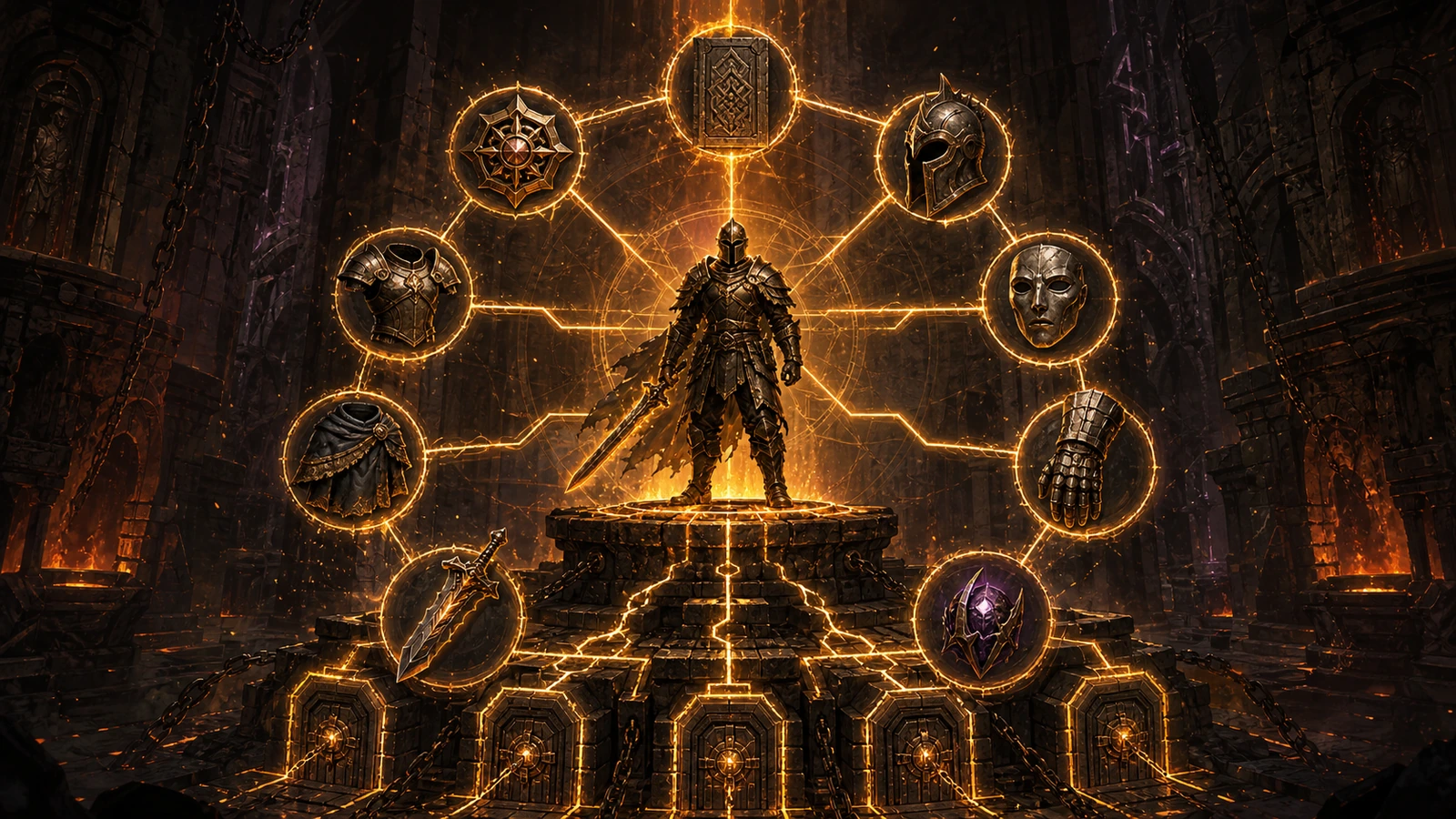
Instead, the selected NFTs are re-locked under UTXO smart-contract rules. The contract-controlled state has no ordinary private key that an administrator can use to move the assets at will. The assets can move only through transaction paths permitted by the contract.
A new Hero is then minted and cryptographically bound to those exact original parts.
The easiest mental model is a keyless on-chain Vault.
The original NFTs enter the Vault. The Hero becomes the transferable redemption right to the precise assets inside it.
That distinction matters.
A forged Hero is not merely proof that some components once existed. It represents a live relationship to components that still exist.
The original parts retain their identity.
The Hero carries their combined form.
And the current Hero holder carries the right to reverse that form and recover the exact originals.
This is why we do not view Soulforge as a burn-to-mint machine with an extra step.
The architecture is built around continuity rather than replacement.
The Soulforge Lifecycle
Soulforge can be understood through four connected stages:
FORGE → BIND → TRANSFER → UNFORGE
Each stage solves a different part of the lifecycle, but the system only becomes meaningful when all four operate together.
Forge creates the Hero without surrendering the original assets to a custodian.
Bind preserves the exact relationship between the Hero and its components.
Transfer allows ownership of the Hero—and therefore the right attached to its origins—to move freely.
Unforge concludes the Hero’s active lifecycle and returns the exact original NFTs.
Together, these stages turn a collection of static assets into a reversible ownership structure.
I — FORGE: Your Assets Enter a Contract, Not a Custodian
The Forge begins with the holder.
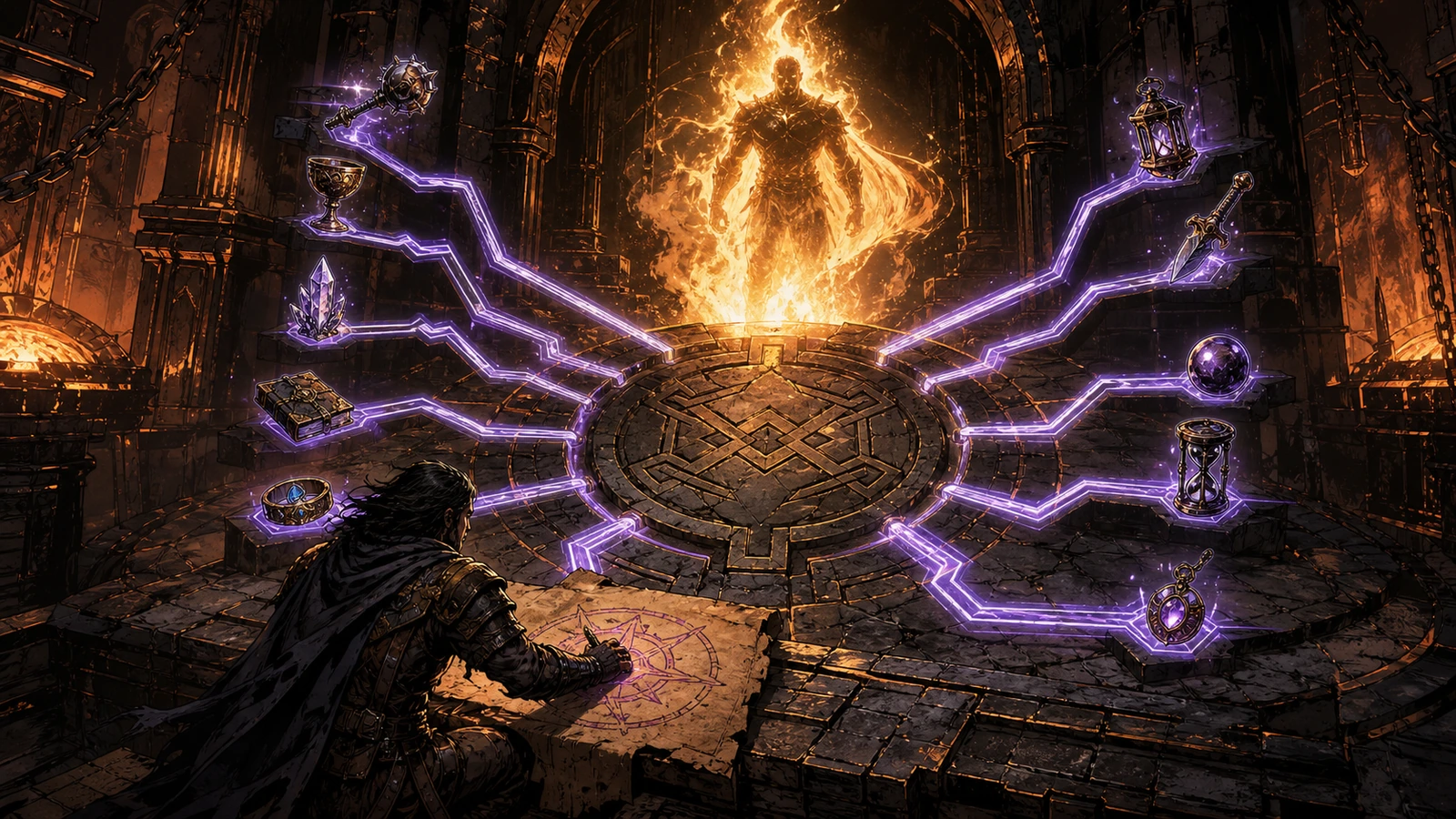
A player selects a valid set of Dungeon Saga Hero parts and signs using their own wallet. The application can help validate whether the selected assets satisfy the recipe and can render the resulting Hero, but validation is not custody.
The selected NFTs are re-locked from the player’s spendable ownership into a contract-controlled UTXO state.
This is a critical distinction.
Dungeon Saga does not receive the NFTs into an ordinary project wallet. There is no administrator sitting behind a private key that can simply withdraw the parts. The contract address has no corresponding private key that functions like a normal custodial wallet.
The assets can move only through transaction paths allowed by the smart-contract rules.
If the Forge cannot be completed within the permitted window, the Intent contract provides a timeout/refund path that allows the original assets to be released back to the player rather than remaining indefinitely trapped in an incomplete process.
The backend can help coordinate the experience. It can verify game-specific rules. It can confirm that the recipe is valid. It can generate the visual representation of the Hero.
But it never needs to possess the underlying assets.
That is the boundary Soulforge is designed to preserve:
The service helps interpret the rules.
The contract controls the assets.
Your NFTs enter a contract—not a company wallet.
An Atomic On-Chain Birth
The decisive Forge transaction is designed as one indivisible state transition.
Three things happen together:
- A new Hero is minted.
- The Hero is sent directly to the player.
- The original parts are locked inside the Vault and bound to that Hero.
These are not independent backend steps that can complete in arbitrary order.
All required conditions must be correct, or the transaction is invalid.
The system does not permit a valid outcome where the original parts are locked but the corresponding Hero is missing. It does not permit the Hero to be redirected to the backend instead of the intended recipient. It does not permit only part of the selected set to enter the Vault while the rest remain outside.
The Hero and its origins are created as one coherent state.
That atomicity is important because it reduces the number of intermediate states a user must trust.
There is no moment in the successful Forge lifecycle where the user has surrendered the parts and is simply waiting for Dungeon Saga to “send the Hero later.”
The Hero is not a reward distributed by a server after custody has changed.
It is the output of the same contract-governed transition that secures its origins.
The Hero and its history are born together.
II — BIND: A Hero That Carries Its Origins
Forge creates the Hero. Binding gives it memory.
Every forged Hero is linked to the precise assets that created it.
That relationship is not intended to be reconstructed from a private database whenever ownership changes. The Binding and Vault states preserve the connection between the Hero and the original parts.
A forged Hero therefore carries a verifiable lineage:
- the original NFTs used to create it;
- the identity and provenance of those NFTs;
- the Hero produced from those assets;
- the Vault in which the originals remain locked; and
- the contract-defined right of the current Hero holder to release them through Unforge.
This changes what “provenance” can mean for a composite NFT.
Normally, provenance tells us where an NFT came from and how it moved between wallets.
Soulforge adds another layer: what the asset is made from.
A Hero can have a visible identity and a component history at the same time.
The original NFTs do not lose their identity merely because they are participating in the Hero. They remain the originals. The Hero gives them a new form without erasing their past.
That is why we describe Soulforge as giving an NFT memory.
The Hero remembers its origin because the origin remains structurally attached to it.
III — TRANSFER: Ownership Moves. The Redemption Right Moves With It.
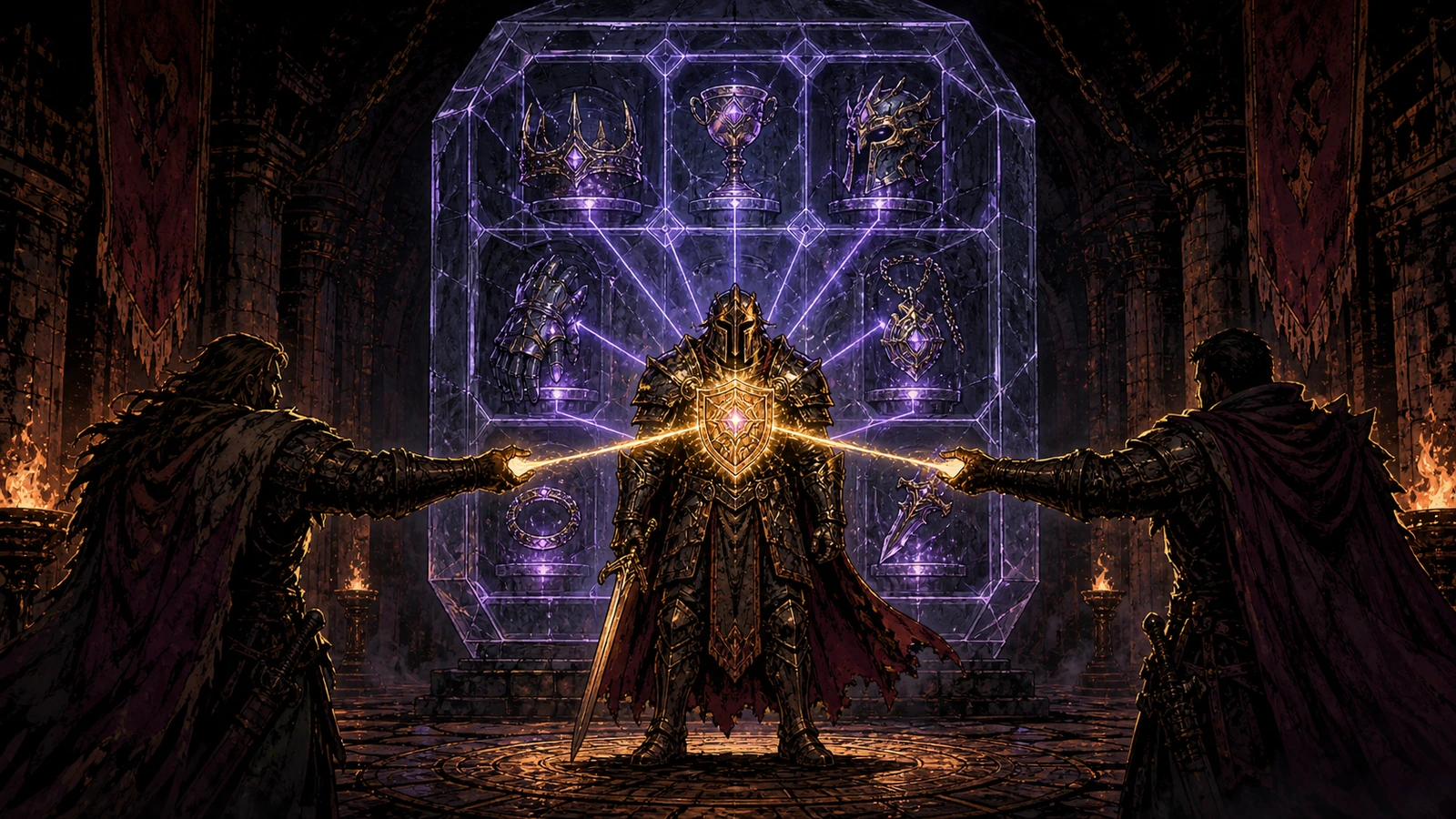
A forged Hero is not meant to become trapped inside Soulforge.
It can be transferred like another NFT.
The original parts remain locked in the Vault while the Hero moves from one wallet to another. But the Hero does not travel alone.
The right to Unforge moves with it.
This is one of the most important properties of the system.
When a buyer acquires a forged Hero, they are not simply purchasing its appearance. They acquire the contract-defined right attached to that Hero’s current ownership: the right to conclude its lifecycle and release the exact original NFTs bound inside its Vault.
Whoever legitimately holds the Hero holds the right to unlock its origins.
This means the Hero can function as a single transferable representation of a more complex underlying asset structure.
Instead of requiring eight individual components to be sold and transferred separately, the forged Hero can move as one coherent object while preserving the relationship to all of its originals.
The Hero moves.
Its lineage moves with it.
Its redemption right moves with it.
And the underlying components remain protected until the current owner decides what happens next.
IV — UNFORGE: End the Hero. Recover the Exact Originals.
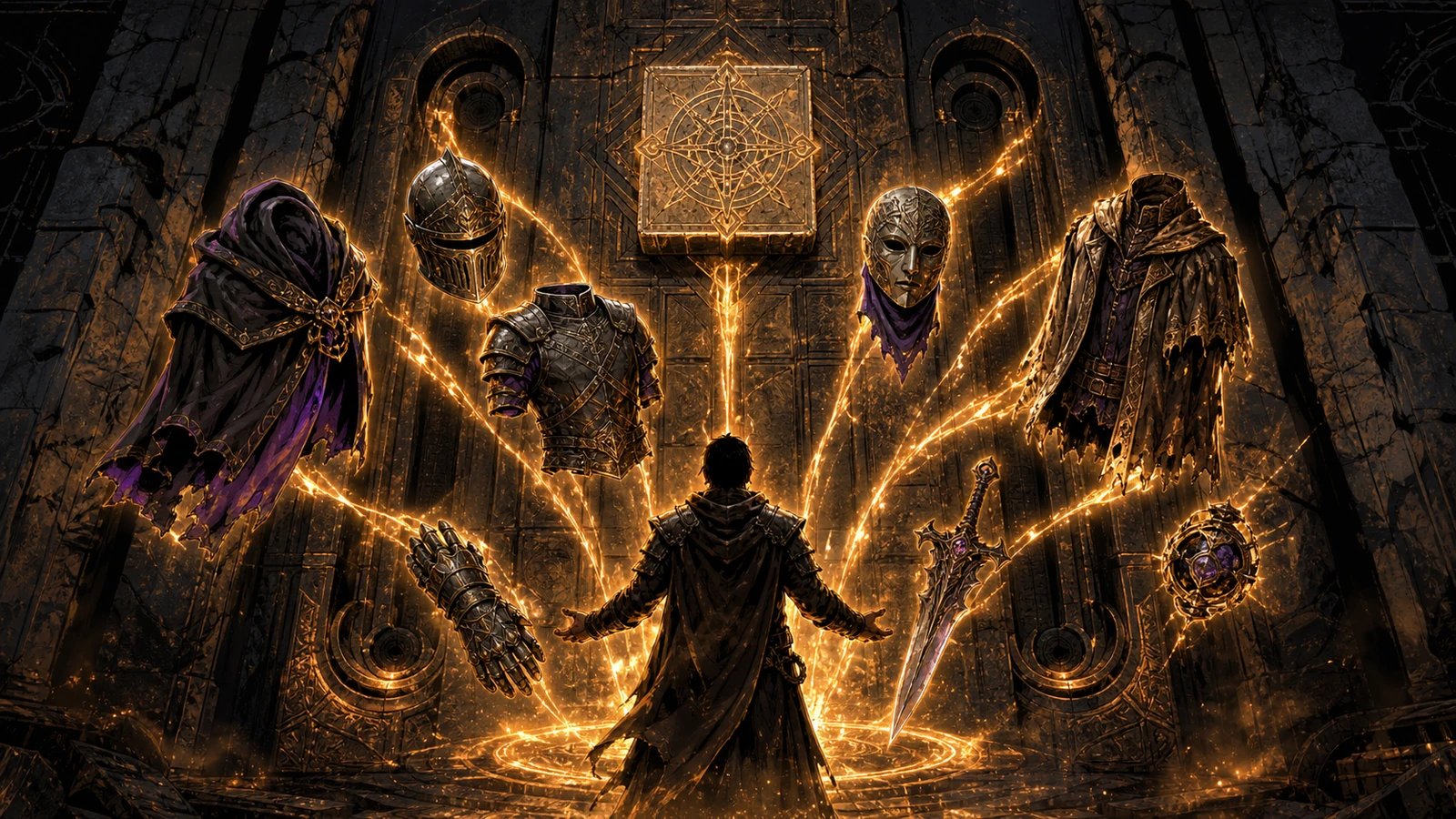
The most unusual part of Soulforge is not that it can create a Hero.
It is that the process can be reversed without pretending the past never happened.
The current Hero holder may choose to Unforge.
They do not first send the Hero to Dungeon Saga. They use the Hero in their own wallet to authorize the Unforge transaction.
A valid Unforge consumes the Hero, its Binding state, and the corresponding Vault state as part of the transition. The Hero’s valid active lineage ends, and the original components are released directly to the current holder.
The exact originals.
Not assets of the same category.
Not newly minted copies.
Not replacements with equivalent metadata.
Not an estimated equivalent.
The precise NFTs that entered the Forge.
If the Unforge transaction is invalid, the lifecycle does not partially execute. The Hero and its locked components remain in their existing valid state.
If it succeeds, the Hero is retired and the original NFTs are released. Those parts can then be held independently, transferred, traded, or potentially used in a future valid Forge.
This is what makes reversibility meaningful.
A system that burns eight assets and later mints eight replacements is not restoring the origin. It is creating a simulation of the origin.
Soulforge preserves the origin itself.
The Hero’s legend can end.
Its history does not disappear.
Its origins return.
What Non-Custodial Actually Means
“Non-custodial” should describe an architecture, not a marketing mood.
For Soulforge, the term refers to who can control the assets and under what conditions they can move.
The original parts never enter a Dungeon Saga-controlled wallet.
No ordinary private key controls the contract-owned parts.
The backend cannot redirect the locked NFTs to itself.
The Hero is minted directly to the player.
The valid Unforge path retires the Hero before releasing the exact originals to the current Hero holder.
A timeout path exists to protect the user if a Forge cannot be completed within its permitted window.
And when originals are released, they are the same NFTs that entered—not substitutes.
This does not mean software disappears from the experience. Soulforge still has application logic. The service can validate a recipe, coordinate transactions, and render the Hero. Dungeon Saga still defines game rules around what combinations are valid.
But there is a fundamental separation between validating an experience and controlling the assets inside it.
The backend can say, “This combination is valid.”
It cannot say, “We now own your parts and promise to give them back later.”
The contract defines where those assets are allowed to go.
That distinction reduces a category of trust that is common in NFT crafting systems.
Players do not need to trust Dungeon Saga to return assets that Dungeon Saga never held in custody.
Beyond Ordinals
Ordinals opened a new chapter for Bitcoin.
By assigning identities to individual satoshis, tracking them through transactions, and enabling immutable content to be inscribed on-chain, Ordinals transformed Bitcoin into a home for digital artifacts.
That breakthrough established identity and permanence.
But the base Ordinals protocol was not designed to provide a stateful smart-contract lifecycle for complex asset transformations.
On its own, it does not enforce the full set of behaviors Soulforge requires: multi-NFT contract locking, atomic Hero creation and component binding, transferable redemption rights, covenant-controlled reversible Hero retirement, and exact recovery of original inputs.
Soulforge is not a replacement for Ordinals.
It is an experiment built at the frontier opened by them.
Ordinals made Bitcoin NFTs possible.
Soulforge explores what Bitcoin-native NFTs can do once they are able to participate in programmable lifecycle rules.
The shift is subtle but important.
The first era of Bitcoin NFTs asked: Can an artifact live permanently on Bitcoin?
The next era can ask: What can that artifact become while preserving the properties that made Bitcoin ownership meaningful in the first place?
Can assets combine without surrendering custody?
Can identity evolve without erasing provenance?
Can ownership of a composite object carry rights to its underlying components?
Can transformation be reversible rather than destructive?
Soulforge is one answer to those questions.
A New Primitive for Bitcoin NFTs
We use the word “primitive” deliberately.
A primitive is not valuable because one application uses it. It is valuable because it introduces a reusable building block—a new way of expressing ownership or behavior that can support many applications.
Soulforge begins with a very specific use case: eight Dungeon Saga NFT parts becoming a complete Hero.
But underneath that experience are more general ideas:
Non-custodial assembly.
Exact component binding.
Atomic creation.
Transferable redemption rights.
Reversible transformation.
Exact original-asset recovery.
Based on the public information available to us and to the best of our knowledge, Soulforge is the first—and currently the only—BTC NFT system to unite all of these properties within one coherent UTXO smart-contract lifecycle.
That claim is intentionally qualified. Bitcoin development moves quickly, and new experiments are constantly appearing. What matters more than being first is the design space the system demonstrates.
For the first time in this model, a BTC-native Hero is not merely an image with metadata describing traits.
It has actual components.
Those components have their own identities.
The Hero has provenance connected to them.
The current holder inherits a transferable right over the structure.
And the structure can be unwound to recover the exact original assets.
The Hero has memory.
It has a lifecycle.
And that lifecycle can return to its origin.
This is why Soulforge should not be understood only as a crafting feature.
Crafting is the first interface.
The deeper idea is reversible, non-custodial composition of Bitcoin-native assets.
Why Reversibility Matters
Digital asset systems have often treated evolution as destruction.
Upgrade an item: burn the old one.
Merge several NFTs: destroy the inputs.
Craft a new asset: sacrifice what came before.
That model is simple, but it creates a permanent tradeoff between progress and provenance.
Soulforge introduces another possibility.
Evolution does not have to erase history.
A collector can choose to express eight assets as one Hero. A future collector can acquire that Hero as a single object. And if the new owner values the components differently, the structure can be unwound and the originals can re-emerge.
That optionality can matter in games, collections, marketplaces, and other ownership systems.
It means a composite asset does not have to permanently consume the liquidity or identity of its components.
It means a transformation can be meaningful without being final.
And it means the history of an asset can include multiple states rather than a single irreversible endpoint.
In Dungeon Saga terms, a Hero can awaken, travel, change hands, and one day return to the relics from which it was forged.
In protocol terms, the asset has a reversible lifecycle.
Beyond Dungeon Saga: A New Design Space
Soulforge begins with Dungeon Saga Heroes because games are a natural place to demonstrate composable ownership.
Games are full of objects that want to combine.
Weapons attach to characters.
Armor completes sets.
Relics unlock abilities.
Characters evolve.
Items are crafted.
Identities change.
Traditionally, most of these relationships live inside a game database. The user may own an NFT representing the final character, but the structure underneath it is often simulated by a centralized application.
A non-custodial composition primitive opens a different design space.
Imagine a Bitcoin-native character assembled from independently owned equipment, where the complete character can move as one asset while the original equipment remains verifiably bound underneath.
Imagine a vehicle assembled from several collectible components.
Imagine a digital artifact that represents a basket of other artifacts, where ownership of the top-level asset carries a transparent right to recover the originals.
Imagine upgrades that can later be reversed.
Imagine evolving identities that do not require their previous state to be destroyed.
Soulforge does not claim to solve every version of these problems. It demonstrates one architecture for making this class of experience possible using UTXO smart-contract rules.
That is why we believe its significance extends beyond the Dungeon Saga game loop.
The Hero is the first expression.
The primitive is the larger idea.
Where Technology Meets the Dungeon Saga IP
Soulforge is a technical system, but it was designed to serve a world.
Dungeon Saga is being built as a dark-fantasy IP where storytelling, digital ownership, community, and gameplay reinforce one another.
The comics reveal the history of Kronos.
The lore gives meaning to its kingdoms, factions, relics, Heroes, and monsters.
Trait NFTs represent pieces of those identities.
Soulforge turns those fragments into complete Heroes.
Those Heroes are designed to become persistent identities within the wider Dungeon Saga ecosystem, including future game experiences and the $SAGA economy.
This relationship matters to us.
Technology without story can become a demonstration.
Story without ownership can become passive entertainment.
Our goal is to connect the two.
The lore explains why the fragments matter.
The ownership layer makes those fragments real digital assets.
Soulforge gives them transformation.
The Hero gives that transformation identity.
And the game can ultimately give that identity agency.
This is the larger direction behind Dungeon Saga: not an NFT collection with lore attached afterward, but a world in which story, assets, and interactive systems are designed to grow together.
The Soulforge is where that philosophy becomes visible on-chain.
The Frontier Ahead
Bitcoin’s culture has always valued ownership, verification, and permanence.
As Bitcoin-native applications become more expressive, the challenge is not simply to add complexity. It is to add capability without abandoning those principles.
Soulforge is one experiment in that direction.
It demonstrates that a digital asset can change form without requiring its owner to trust a centralized custodian.
It demonstrates that a composite NFT can preserve the exact assets from which it was created.
It demonstrates that the right to recover those assets can move with the composite object.
And it demonstrates that transformation can be reversible.
There is much more to explore.
How might marketplaces display the component structure of a forged asset?
How might games build equipment, crafting, and progression systems around recoverable components?
How might provenance evolve when an asset has not only a transfer history, but a transformation history?
How might other UTXO-based applications use transferable redemption rights?
Those questions extend far beyond one Hero.
That is the point.
A useful primitive creates possibilities that were not obvious before it existed.
The Forge Is Open
Today, Soulforge begins with Dungeon Saga.
Eight parts can become one Hero.
That Hero can travel.
Its history can travel with it.
And when its legend ends, the exact pieces that gave it life can return.
No burn-to-mint replacement.
No project-controlled custody.
No substitute originals.
A lifecycle enforced through BTC-native UTXO smart contracts.
Bitcoin gave digital artifacts permanence.
Ordinals gave them identity.
Soulforge gives them a new dimension: evolution without erasure.
Not by replacing history, but by preserving it.
Not by asking users to surrender ownership, but by encoding the valid paths ownership can take.
Not by turning the original assets into memories, but by allowing the Hero itself to carry those memories forward.
The first Heroes are awakening.
But the larger story is only beginning.
Gather your relics.
Forge your Hero.
Carry its history.
And when the legend must end, reclaim every piece of its origin.
FORGE THE HERO. OWN THE ORIGIN. UNFORGE THE LEGEND.